
-
The Ghost of Absurdity
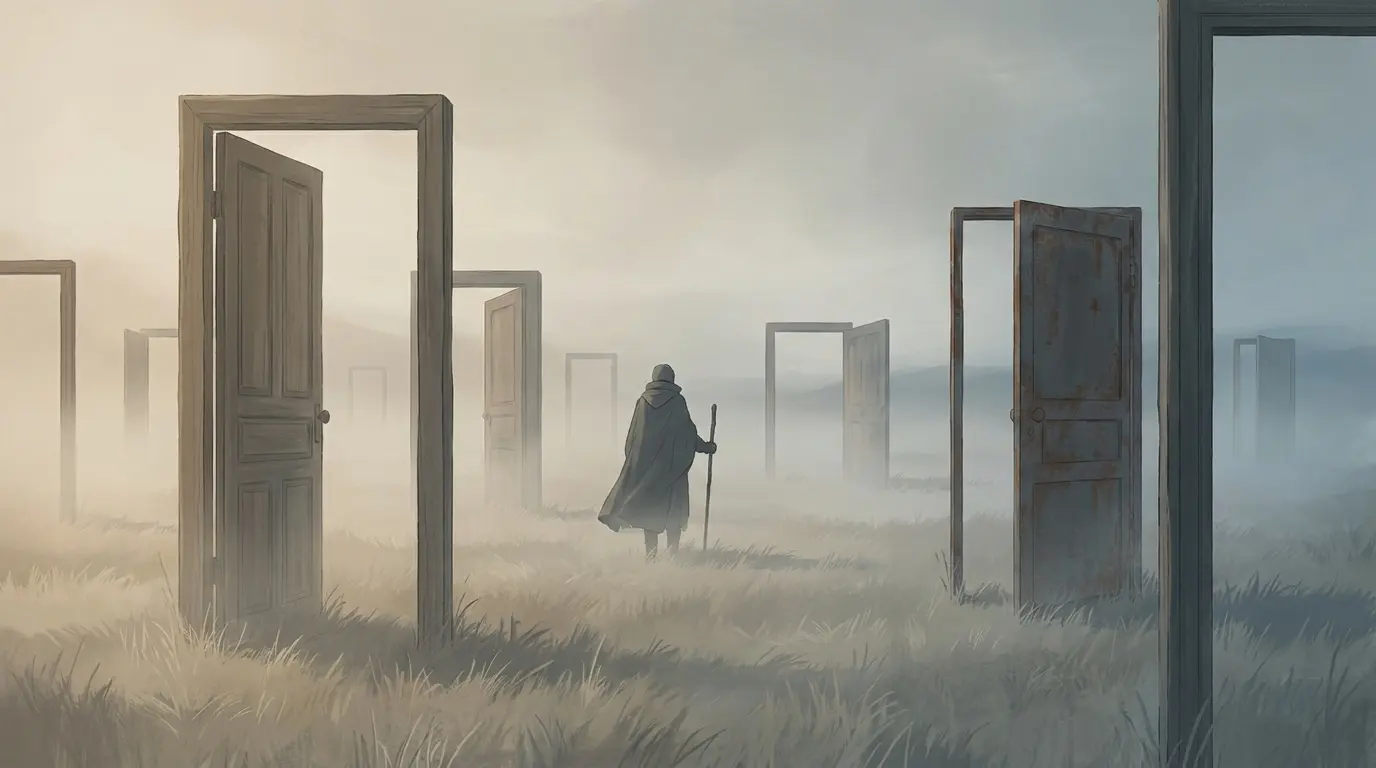
We are the first generation to live in the shadow of a silent sky. Modern existence is frequently haunted by a cold, subterranean suspicion: the fear that life, in all its sprawling complexity, is fundamentally devoid of a script. We find ourselves caught in a tightening vice between what Albert Camus called the “unreasonable silence of the world” and an irrepressible human hunger for a coherent story. If the universe refuses to speak, we feel the desperate urge to speak for it. Yet, moving from a narrative of absurdity to one of meaning is not a matter of discovering a hidden map; it is a matter of recognizing that we are the cartographers.
-
The “Scientific” Death of Purpose
For the better part of human history, we lived in an Aristotelian theater where every object and every soul possessed a “final cause”—a goal toward which it was naturally striving. In this religious framework, the universe was a purposeful tapestry woven by a divine hand. However, the scientific revolution essentially stripped the gears from this machine.
Thinkers like W.T. Stace argue that the transition from a teleological cosmos to a blind, evolutionary mechanism did more than just update our textbooks; it “killed religion” for the modern mind. Stace’s grim insight is that the purposelessness of the vast universe necessarily entails the purposelessness of the human life within it. If the whole is an accident, the part cannot be a destiny.
“The world is basically matter and energy that transforms into different forms and this transformation does not have any purpose.”
-
The Irony of Taking Ourselves Seriously
Philosopher Thomas Nagel identifies absurdity not as a property of the stars, but as a collision within the human skull. We live our daily lives with “undiminished seriousness,” agonizing over career paths, moral choices, and personal legacies as if they were etched in stone. Yet, we possess the uniquely human ability to take a “step back”—to view our strivings from a cosmic distance where our values appear arbitrary and subjective.
While Nagel suggests we should lean into this irony, treating our lives with a playful, detached skepticism, Friedrich Nietzsche offered a more radical escape. For Nietzsche, the “death of God” was not a funeral but a liberation. Rather than settling for Nagel’s irony, Nietzsche called for a “Revaluation of all Values,” suggesting that meaning is a manifestation of power—the power to create a new “take” on the world that honors our own vitality rather than an external authority.
-
The Pendulum of Pain and Boredom
If irony is the mental shield we use to survive our own subjectivity, it often fails against the relentless psychological swing of existence. We must distinguish between two flavors of absurdity here: the ontological and the psychological. Camus focused on the ontological—the “unreasonable silence” where our demand for reason meets a world that offers none.
Arthur Schopenhauer, however, looked inward to the “Will” and found a psychological trap. He argued that human life is driven by a fundamental lack, which manifests as pain. When we satisfy our desires, we don’t find peace; we find a “fearful emptiness.”
“Life swings like a pendulum to and fro between pain and boredom, and these two are in fact its ultimate constituents.”
Where Camus suggests we rebel against the silence, Schopenhauer suggests we stop the pendulum by ceasing to will altogether. Both agree, however, that without a narrative intervention, the mechanism of life is rigged for dissatisfaction.
-
Meaning is a Narrative, Not a Mathematical Proof
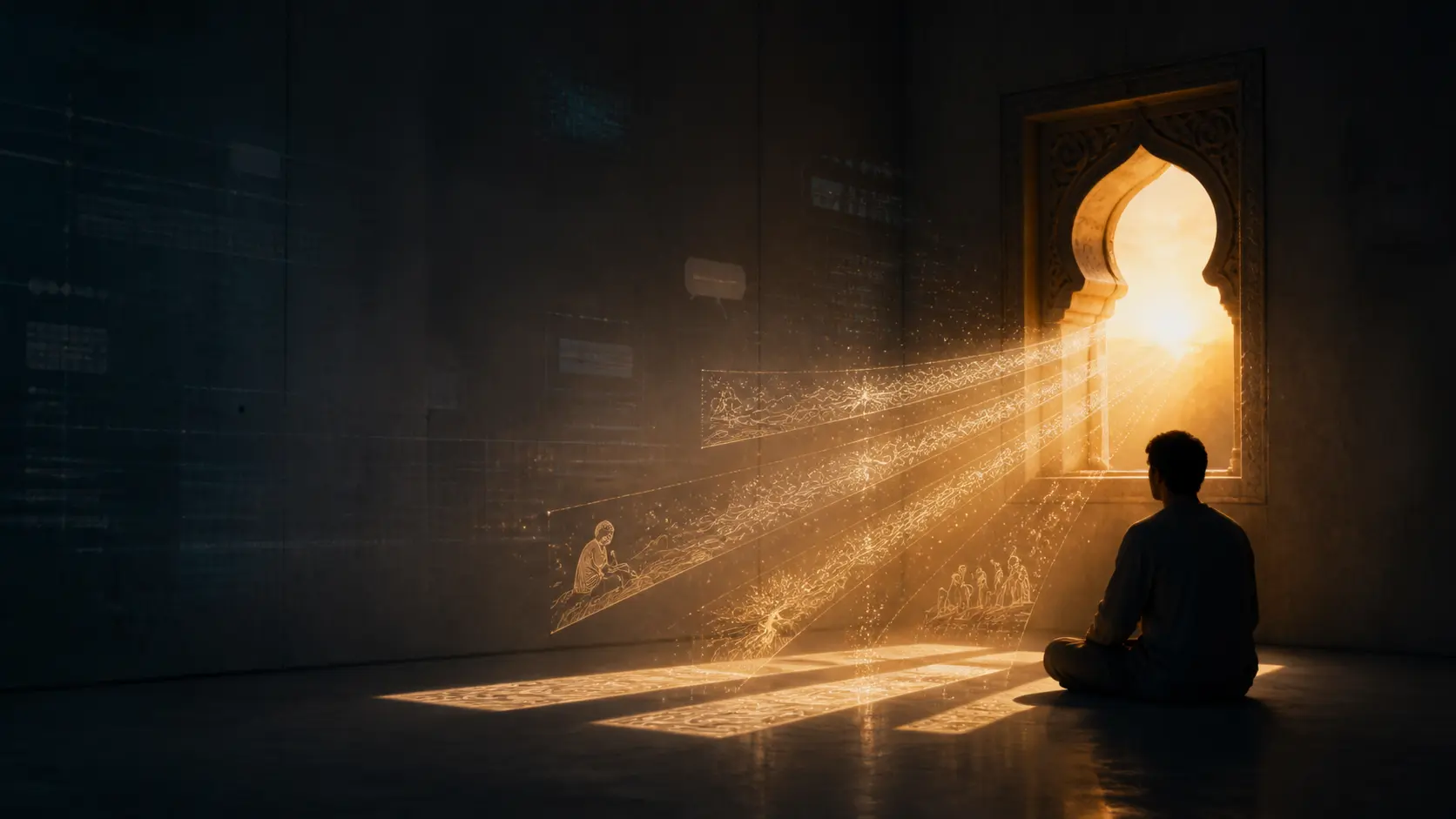
The central error of the modern age is seeking meaning as if it were a mathematical proof or a chemical element. In reality, meaning is a “medium.” As philosophers like Wittgenstein and Charles Taylor have suggested, we do not see the world “as it is,” but through a “picture” or a “take.” We inhabit narratives that act as the lens through which reality becomes intelligible.
A life narrative is not a verbatim transcript; it is a creative construction characterized by three features:
- Selective: It highlights specific turning points while relegating others to the background.
- Unifying: It weaves causal threads through random events, turning a “sequence” into a “consequence.”
- Isomorphic: It maps our unique struggles onto universal human patterns, making our private pain shareable.
-
The “Film Set” Shift—How Faith Changes the Scene
To change the meaning of your life, you don’t necessarily need to change the facts of your life; you need to change the context. John Hick offers a masterful analogy: Imagine wandering into a room where a violent coup is being plotted. You are paralyzed by terror until you glance into the rafters and spot the cameras. You realize you have accidentally walked onto a film set.
At the “ground level,” nothing has changed—the actors are still armed, the dialogue is still violent. But the significance of the scene has been totally transformed. Religious faith functions as this shift in awareness. By introducing “cosmic optimism”—the belief that the universe is ultimately moving toward a desirable end—faith provides a “higher level” of meaning. It doesn’t delete the suffering of the natural world, but it recontextualizes it as part of a larger, spiritual drama that addresses needs the material world cannot touch.
-
We Have the Power to Choose a Better Story
We are not trapped in a narrative of absurdity unless we choose to stay there. We can evaluate our life stories using two rigorous criteria: Truth and Practical Reasoning.
First, we must seek a “factive” or “quasi-factive” narrative. As Jonathan Kvanvig suggests, true understanding doesn’t require every peripheral detail to be factually perfect; it requires the core of the story to correspond with the major contours of reality. Second, we use practical reasoning to judge a story by its fruit. If a narrative supports a moral life, reduces suffering, and allows us to see ourselves as a “rightful source of pride”—a concept championed by Susan Wolf and Charles Taylor—it is functionally superior. Choosing a story that fosters self-esteem and identity isn’t “wishful thinking”; it is the highest exercise of human reason.
-
Conclusion: The Final Word on Our Unfinished Stories
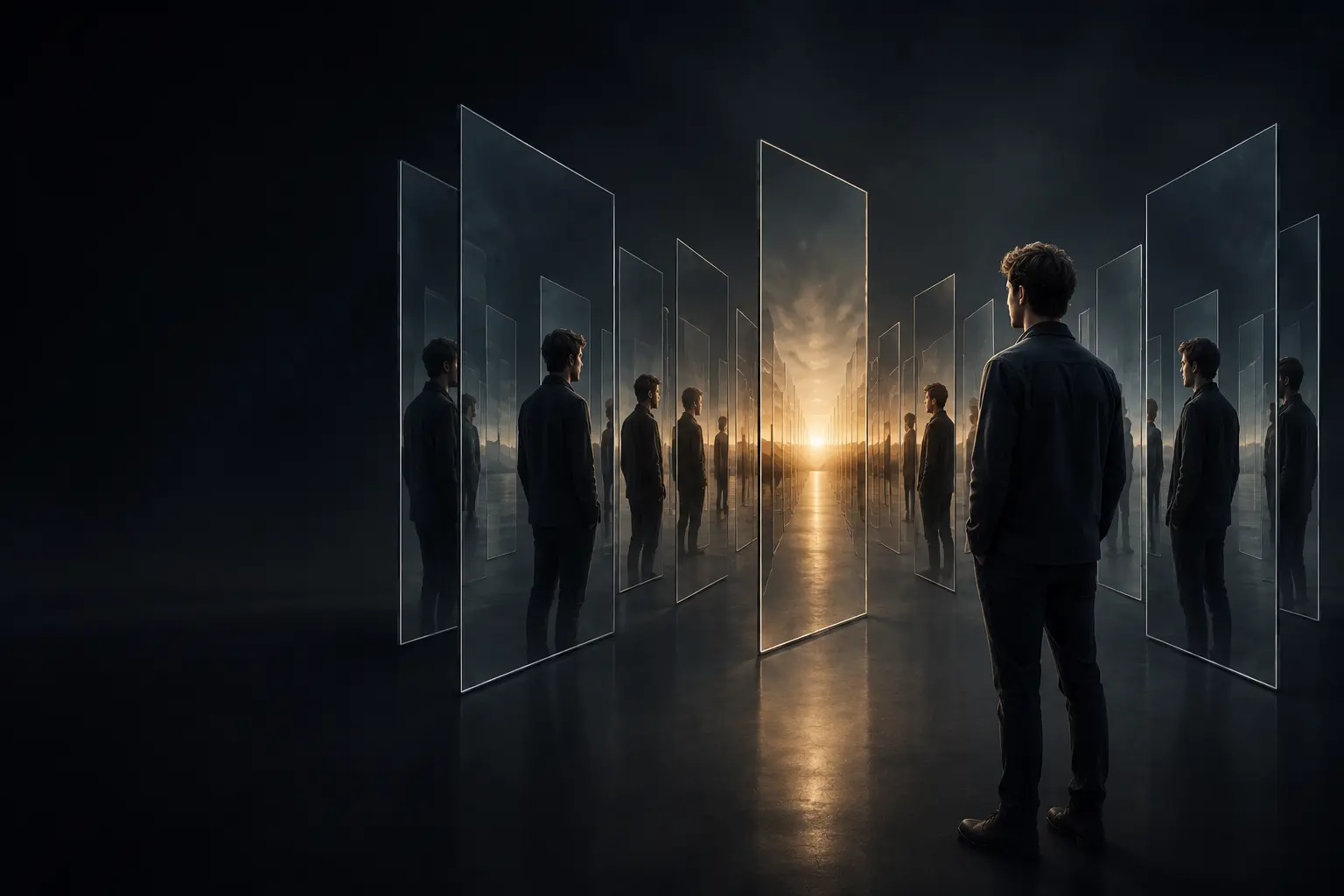
Absurdity is not an objective fact of the universe; it is merely one possible way to recount the data. By reclaiming our role as the “recounters” of our own lives, we move from being victims of a silent world to being authors of a meaningful one. We have the agency to select the elements of our journey that point toward growth rather than decay.
As you stand in the midst of your own unfolding drama, take a moment to look up. If your life were a film set you hadn’t noticed yet, what would the cameras in the rafters reveal about the story you’re actually filming?
Read the Full Version of the article
And if you are interested in absurdity and building a meaningful life, join our course
How to build a meaningful life?