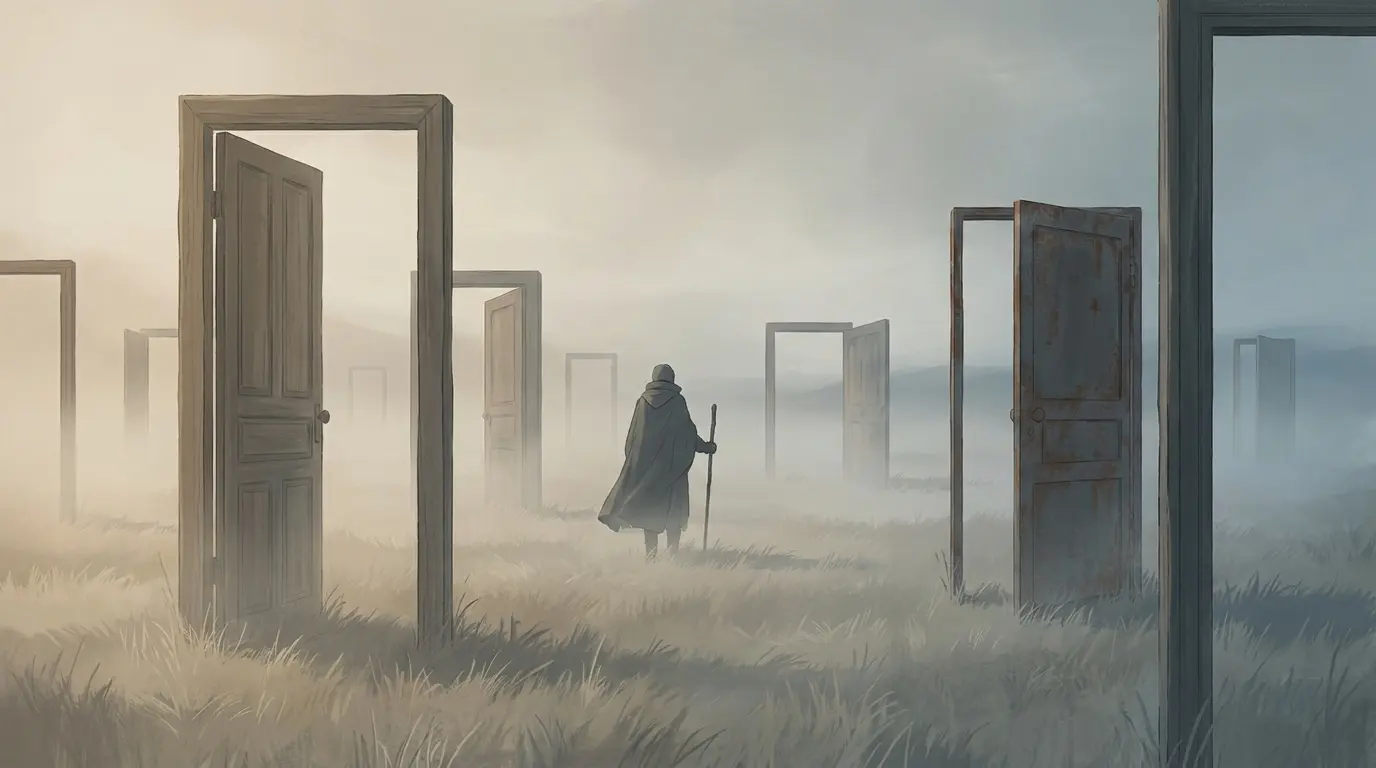
In our hyper-connected yet profoundly lonely era, we find ourselves caught in a crossfire of worldviews. On one side, a rigid “naturalism” insists that meaning is a byproduct of biology and physics—measurable, but ultimately hollow. On the other, “absurdism” offers a shrug in the face of what Albert Camus called the “unreasonable silence of the world.” In the echoes of our digital isolation, this silence has never felt louder.
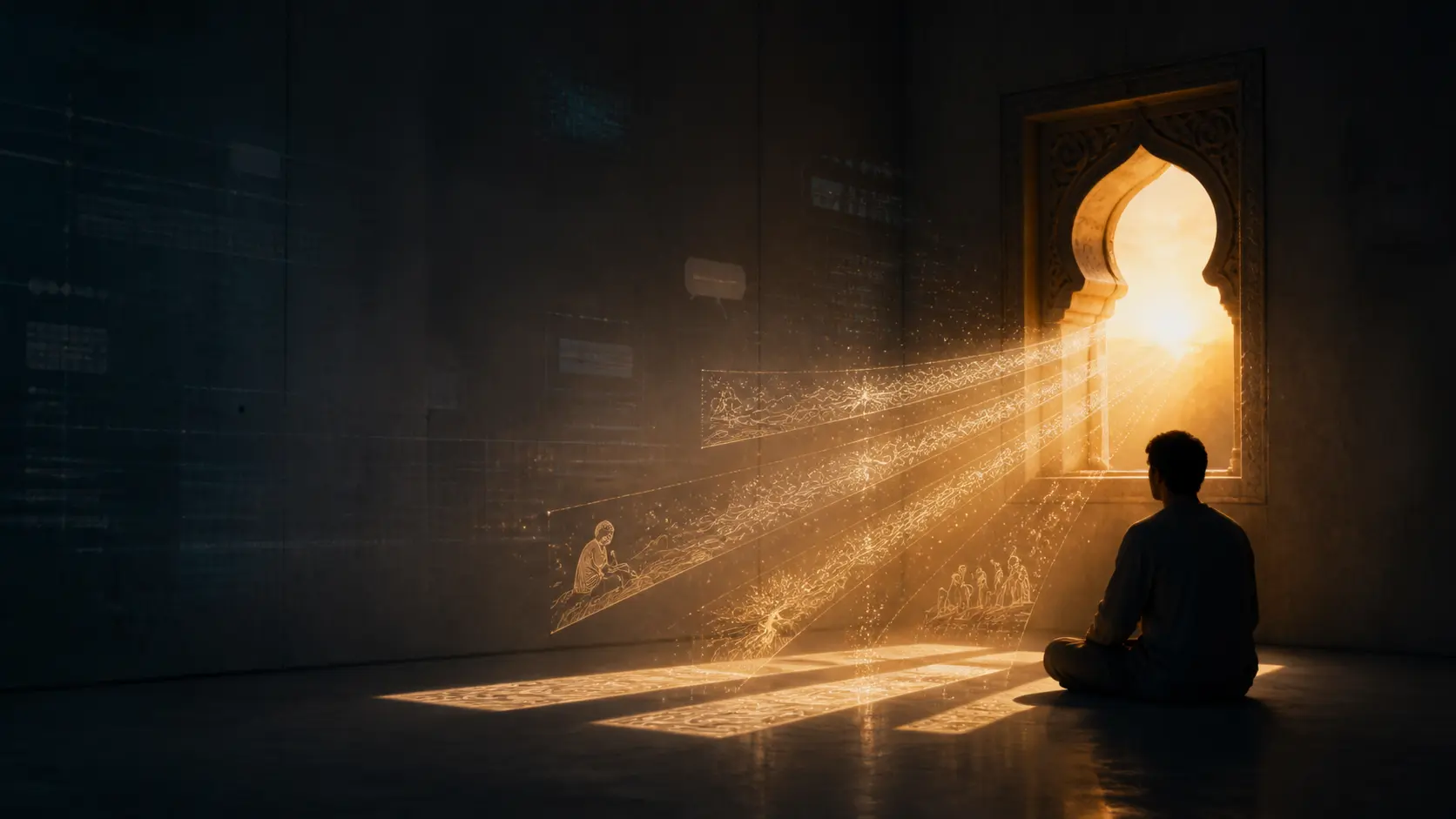
Jalal al-Din Rumi, the 13th-century Sufi philosopher, offers more than just poetry for this modern malaise; he provides a “technology for perception.” Rumi was a committed “supernaturalist,” but not in the way we might expect. He didn’t reject the natural world; he argued that it is an incomplete data set. To Rumi, the physical world is a room, and a room without a “peephole” toward the light is not just dark—it is a spiritual prison.
This perspective does not merely offer individual solace; it reimagines the very architecture of interfaith connection. By treating our “universal ache” for meaning as a shared biological and spiritual fact, Rumi transforms the “religious other” from an adversary into a partner.
We turn now to five windows opened by Rumi—vital tools for navigating a globalized, fragmented future.
1. The Symphony of Separation: Life as a “Lament”
Rumi suggests that the pervasive sense of “agony” or dissatisfaction we feel in the modern world is not a bug in the human system, but its most important feature. He frames the human condition through the narrative of the “reed-flute,” an instrument that produces its haunting melody only because it has been cut away from its source.
Now listen to this reed-flute’s deep lament About the heartache being apart has meant: ‘Since from the reed-bed they uprooted me My song’s expressed each human’s agony… When kept from their true origin, all yearn For union on the day they can return.
In a “Spiritual Futurist” framework, this shifts the meaning of life from “accumulation” to “return.” Our shared existential pain becomes the proof of our common beginning. If we are all “reeds” cut from the same bed, then our various cultural and religious songs are simply different expressions of the same original ache.
2. Epistemic Humility: The Elephant in the Post-Truth Age
Religious and philosophical conflicts often arise from the “absolutation” of truth—the belief that our specific window is the only one that faces the sun. Rumi addresses this through his famous allegory of the “Elephant in a Dark Room,” where seekers touch different parts of an animal and mistake the trunk for a waterpipe or the leg for a pillar.
Rumi’s insight here is a precursor to modern “historicism”—the understanding that our perception of truth is always relational, conditioned by our standpoint in time and space. He offers a striking paradox to explain our sectarian divisions: “the truth is drowned within the truth.”
Because the ultimate reality is so vast and multi-layered, our disagreements are not evidence of falsehood, but of the complexity of the “animal” we are trying to describe. Peace becomes possible only when we adopt “epistemic humility,” acknowledging that our viewpoint is, by definition, limited.
3. The Collective Journey: Many Roads, One Horizon
In his work Fihi ma fih, Rumi offers a framework for religious pluralism that preserves the integrity of individual paths while acknowledging a singular destination. He compares the world’s religions to travelers arriving from Rome, Syria, Persia, and China, all converging on the Kaaba.
The ways may vary, but the goal is one. Don’t you see that there are many roads to the Kaaba?… So if you consider the roads, they are beyond counting, with infinite differences. But when you consider the goal they are all in accord with one desire… once we arrive at the Kaaba, we realize that such fighting is over the roads only, and that the goal of all is the same.
In Rumi’s view, the “religious other” is not a subject for investigation or a target for conversion, but a fellow wayfarer on a “collective journey.” This allows us to walk our specific path with total devotion while recognizing that our neighbor’s path—though geographically distinct—is oriented toward the same shared horizon.
4. The “Grapes” of Contention: The Primacy of Meaning
Rumi argues that most human conflict is a linguistic tragedy—a fight over the “color” of a truth that is fundamentally “colorless.” He illustrates this with the story of four men—an Arab, a Turk, a Persian, and a Greek—who fight over how to spend a single coin, each using a different word for what they want:
Angur (Persian)
Enab (Arabic)
Uzum (Turkish)
Estafil (Greek)
They descend into violence, unaware they are all asking for grapes. This “primacy of meaning over form” is Rumi’s most radical peace offering. He suggests that even archetypal enemies can find common ground when they transcend labels. In one profound verse, he notes that when “colorlessness is acquired,” even Moses and Pharaoh make peace. By stripping away the “colors” of sectarian labels, we find the “colorless” truth that lies beneath the form.
5. Dialogue as “Becoming”: Beyond Information Exchange
Perhaps Rumi’s most vital contribution to our future is shifting the goal of dialogue from “knowing” to “becoming.” Traditional interfaith dialogue is often an sterile exchange of data—learning about the other. Rumi proposes an existential transformation.
This shift is already being mirrored in modern institutional movements. The spirit of Nostra Aetate from the Second Vatican Council, which recognizes Muslims as fellow truth-seekers, echoes the Quranic invitation (3:64) to a “Common Word”—the shared worship of the One.
When we engage with the “other” as a partner in spiritual enrichment, dialogue ceases to be a theological debate and becomes a shared “becoming.” We don’t just learn about another’s faith; we use their perspective to expand our own “peephole” toward the divine.
Conclusion: Beyond the Peephole
Rumi teaches us that “to make a window… is the foundation of religion.” Without this connection to the beyond, our lives are confined to the material “room,” and as Rumi starkly warns, a house without a window is Hell.
To navigate the fragmented landscape of the 21st century, we must carry two tools: epistemic humility to recognize our limited perspective, and empathy to see the beauty in another’s path. Rumi’s supernaturalism is not a flight from reality, but a deeper engagement with it—an insistence that there is more to the data set of human existence than what we can touch in the dark.
As we move forward into an uncertain future, we are left with one vital question: Are you currently fighting over the road, or are you walking toward the destination?
Read the full version of the article and
If you are interested in Religious Diversity, join our course
Religious Diversity